
What Is Revenue Cycle Management and Why Does It Matter?
Revenue is essential for every business, but effective collection is often challenging. From closing a deal to receiving payment, each administrative, financial, and operational step must be executed accurately. Missing even one step can disrupt cash flow, while repeated errors can significantly impact the entire organization.
Revenue cycle management addresses this challenge. Regardless of industry, understanding RCM can determine whether a business grows steadily or loses revenue through preventable gaps.
This guide explains what revenue cycle management is, why it matters, how it works, common challenges, and the impact of modern technology.
What Is Revenue Cycle Management (RCM)?
Revenue cycle management (RCM) is the end to end process of tracking, managing, and collecting revenue generated from products or services. It covers every financial touchpoint in the customer relationship, from the initial agreement or service authorization through invoicing and billing to final payment reconciliation.
The term is most commonly associated with healthcare, where it describes the full financial lifecycle of a patient encounter: registration, insurance verification, coding, claims submission, and payment collection. But the underlying principles apply across industries. Any organization that delivers a service, issues invoices, and waits for payment has a revenue cycle and benefits from managing it well.
At its core, RCM links clinical or operational activities to financial outcomes. Any breakdown in the cycle, such as billing errors, missed authorizations, or delayed invoices, creates friction that slows cash flow and increases administrative costs.
Why Is Revenue Cycle Management Crucial for Financial Health?
RCM is more than a back-office task. When managed effectively, it serves as a strategic driver of financial performance.
Optimized revenue cycles improve cash flow by accelerating payments, maintaining lean accounts receivable balances, and ensuring sufficient liquidity for operations and investment. Inefficient cycles result in unpaid invoices and denied claims, which may force organizations to use reserves or postpone growth initiatives.
The cost of poor RCM is high. In healthcare, one of the most complex revenue cycle environments, RCM-related expenses range from 3% to 5% of total patient revenue, according to BillFlash. For a mid-sized hospital with $250 million in annual revenue, this equates to $7 million to $12 million spent each year on billing and collections. Similar patterns exist in other industries: funds used to resolve payment issues or disputes are not available for growth.
Strong RCM also supports better business decision-making. When revenue data is clean, complete, and current, finance leaders can accurately forecast cash flow, model scenarios, and identify where margin is being lost. Without it, decisions get made on incomplete information a costly blind spot.
Key Stages of the Revenue Cycle Management Process
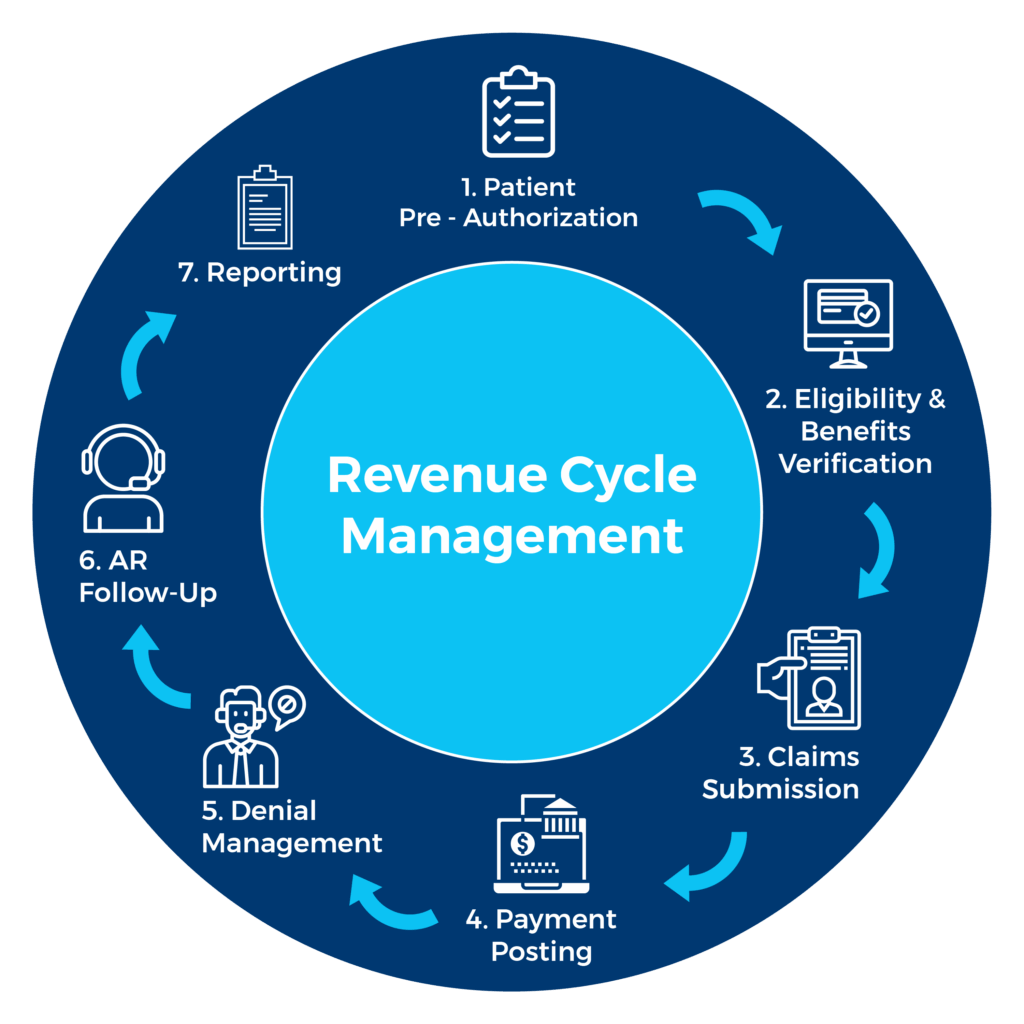
The revenue cycle consists of several interconnected stages, each of which presents potential risks for delays or errors.
- Customer or Patient Acquisition and Onboarding
The cycle begins before a transaction is completed. Accurate collection of customer or patient information, including contact details, contract terms, and payment or insurance information, forms the foundation for subsequent steps. Errors at this stage affect the entire cycle. - Eligibility and Authorization Verification
Before providing services, businesses must confirm that customers are covered, qualified, or financially prepared to pay. In healthcare, this involves insurance verification; in other industries, it may require credit checks or contract approval. Omitting this step often leads to denied payments. - Service Delivery and Charge Capture
After services are delivered, all billable items must be accurately recorded. In healthcare, this is known as charge capture; in professional services, it involves time-tracking or project billing. Undocumented services result in lost revenue. - Invoicing and Claims Submission
Accurate and timely invoices or claims must be submitted to the payer, whether an insurance company, corporate client, or individual customer. The precision of this step directly affects payment speed. - Payment Posting and Reconciliation
Upon receipt, payments must be matched to the correct accounts and reconciled with billed amounts. Any discrepancies should be identified and resolved promptly. - Denial Management and Collections
Not all invoices or claims are paid initially. Denials should be reviewed, corrected, and resubmitted, while outstanding balances require follow-up. Without active management, revenue can be lost at this stage.

Common Revenue Cycle Bottlenecks and How to Fix Them
Each stage of the revenue cycle presents potential bottlenecks where organizations may lose time and money.
Manual Data Entry Errors
Manual data entry error rates range from 1% to 5%, according to BillFlash. In high-volume settings, even a 1% error rate can result in hundreds of billing mistakes each month, each requiring time to detect, correct, and resubmit. To address this, automate data capture and implement validation checks at entry.
Slow Eligibility Verification
Delays in confirming customer coverage or creditworthiness slow the entire cycle. In healthcare, manual eligibility checks may take hours, while automated tools reduce this to minutes, minimizing delays and preventing future payment issues.
High Denial and Rejection Rates
MedCycle Solutions reports that nearly 90% of claim denials are preventable, often due to missing documentation, incorrect codes, or incomplete data. Proactively auditing submissions before sending them significantly improves first pass payment rates.
Lack of Visibility
Many organizations lack real-time visibility into their revenue cycle, making it difficult to track aging invoices or stalled claims. Without this insight, issues can escalate unnoticed. Implementing a centralized dashboard to monitor key metrics, such as days in AR, collection rates, and denial rates, enables proactive management.
The Role of Automation and FinTech in Modern RCM
Technology is quickly changing how revenue cycle management works. According to Nova One Advisor, the AI powered RCM market was worth $25 billion in 2025 and could grow to $219 billion by 2035, with a yearly growth rate of 24.19%. This investment shows just how big the difficulties and prospects are.
A few key technologies are leading this change:
Robotic Process Automation (RPA) handles repetitive tasks for example checking eligibility, creating invoices, and sending payment reminders without needing people to step in. BillFlash reports that electronic verification alone saves about 14 minutes per transaction, which adds up quickly when done at scale.
Machine learning and predictive analytics help forecast how payments will be made, spot likely denials before they happen, and find risk patterns in accounts receivable. For example, R1 RCM’s AI-powered platform has cut denials by more than 30% by catching errors before claims go out.
Natural Language Processing (NLP) now automates documentation and programming tasks that used to need experts, which speeds up the process and makes it more accurate.
Integrated FinTech platforms bring billing, payment processing, and collections together in one workflow. This gives teams full control over the revenue cycle, makes things simpler for staff, and gives leaders real-time financial data.
Cloud-based tools have made these solutions easier to access. What once needed big ıt investments is now available to mid-sized and smaller organizations through simple subscription plans.